


“Plant trees and care for them" — Lands Minister


The Minister for Lands and Natural Resources, Emmanuel Armah-Kofi Buah, has urged Ghanaians to go beyond planting trees and commit to nurturing them to maturity, stressing that the long-term success of the country's reforestation efforts depends on the survival of every seedling planted.
Speaking at the national commemoration of World Environment Day 2026 and the launch of the nationwide Tree for Life Reforestation Initiative at West Africa Senior High School in Accra, the Minister called on citizens, institutions, schools and communities to take ownership of trees planted under the programme.
"Plant trees and care for them," Mr. Buah emphasized, noting that environmental restoration can only be achieved when planted seedlings are protected, watered and monitored until they mature.
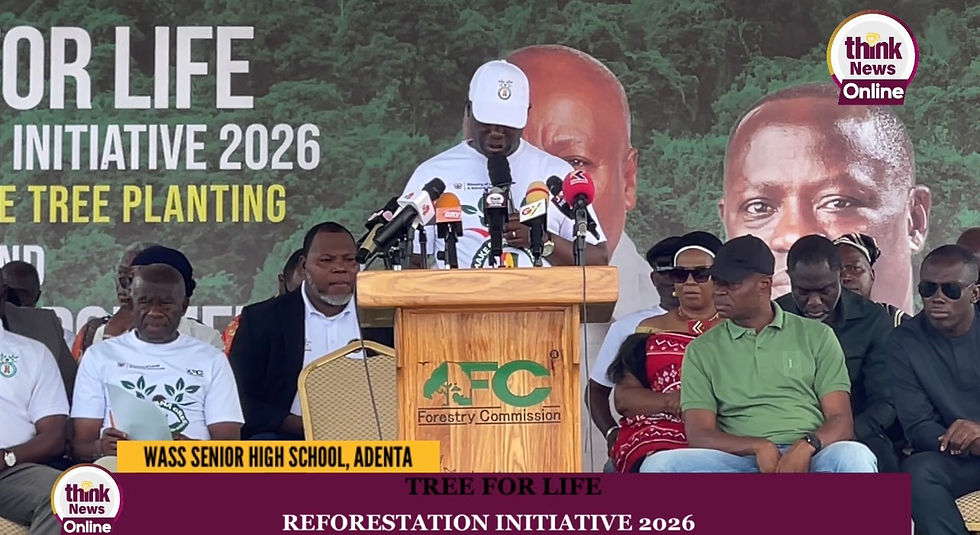
According to him, while Ghana recorded a significant milestone by planting more than 31 million trees under the 2025 Tree for Life Reforestation Initiative, the focus of the 2026 exercise will be on ensuring higher survival rates through effective post-planting care and maintenance.
"The true measure of success is not the number of seedlings planted but the number of trees that survive and mature," he stated.
The Minister announced that government has set a target of planting an additional 30 million seedlings nationwide from June 5 until the end of the rainy season as part of efforts to restore degraded landscapes, increase forest cover and strengthen climate resilience.

Mr. Buah said the initiative aligns with the global theme for World Environment Day 2026, "Inspired by Nature. For Climate. For Our Future," and this year's Tree for Life theme, "Forests and Economies," both of which underscore the vital role of forests in environmental protection and economic development.
He warned that Ghana continues to face the growing impacts of climate change, including erratic rainfall patterns, flooding, droughts, coastal erosion and biodiversity loss, stressing that collective action is needed to safeguard the environment for future generations.
Addressing students, the Minister encouraged them to become environmental ambassadors by planting trees, avoiding littering, conserving water and energy, and promoting environmental awareness in their communities.
He also reiterated government's commitment to broader environmental protection measures, including marine conservation, climate-smart agriculture, renewable energy investments and efforts to address plastic pollution.
Mr. Buah called on all stakeholders to actively participate in the nationwide tree planting exercise, describing environmental sustainability as a shared national responsibility.
"Together, let us build a greener, more resilient and more prosperous Ghana," he said.

On his part, Chief Executive Officer of the Forestry Commission, Dr. Clement Hugh Brown, has emphasized the critical role forests play in sustaining livelihoods, supporting economic growth and protecting the environment.
Addressing government officials, development partners, traditional leaders, students and environmental stakeholders, Dr. Brown said this year's campaign, themed "Forests and Economies," underscores the significant contribution of forests to Ghana's socio-economic development.
According to him, Ghana's forest cover currently stands at approximately 6.4 million hectares, accounting for about 27 per cent of the country's land area.
He noted that an estimated 20 per cent of the population depends directly or indirectly on forests for food, income and health needs.
"Today's celebration is not merely to observe a date on the annual calendar, but to respond to a critical call to action for our planet and our nation," Dr. Brown stated.
He highlighted the economic value of the forestry sector, revealing that in 2025 Ghana supplied about 952,000 cubic metres of timber and timber products to domestic and international markets, generating roughly $260 million in value.
Dr. Brown also disclosed that visits to ecotourism sites within wildlife parks and forest reserves reached approximately 800,000 last year, representing a 20 per cent increase compared to the previous year.
Despite these gains, he warned that deforestation and forest degradation continue to pose serious threats to biodiversity, water resources, climate resilience and the livelihoods of forest-dependent communities.

Reviewing the achievements of the maiden Tree for Life initiative in 2025, Dr. Brown said 23,600 hectares of degraded and deforested lands were restored nationwide.
He added that 30.8 million tree seedlings were planted through collaborations involving the Forestry Commission, private sector actors and civil society organisations.
Encouraged by the progress made, the Forestry Commission is aiming to plant 30 million seedlings this year and is calling on all Ghanaians to actively participate in the exercise by obtaining seedlings from Forestry Commission offices and nurturing them to maturity.
To strengthen forest protection and sustainable management, Dr. Brown outlined several interventions being pursued by the Commission, including a review of the Forestry Commission Act, exploration of Payment for Ecosystem Services schemes, attraction of private investment into ecotourism, establishment of Forest Protection Camps in illegal mining hotspots, enhanced training for frontline personnel and intensified public education campaigns.

He also announced the inauguration of a multi-stakeholder committee tasked with developing a comprehensive forest protection strategy to guide future conservation efforts.
Dr. Brown stressed that protecting Ghana's forests requires sustained investment, strong legal frameworks and collective action from government, communities, civil society organisations, the media and the private sector.
"We must act collectively and decisively to halt deforestation and forest degradation, restore degraded lands and promote sustainable forest management," he said.
The Tree for Life initiative forms part of government's broader efforts to restore degraded ecosystems, mitigate the effects of climate change and secure a greener and more sustainable future for generations to come.
Story by: Joshua Kwabena Smith


Comments