


"Treat pregnant women with disabilities with dignity and empathy" – Deputy Health Minister to health workers


The Deputy Minister for Health, Prof. Dr. Grace Ayensu-Danquah, has called on healthcare professionals across the country to treat pregnant women—especially those living with disabilities—with dignity, empathy and respect, stressing that compassionate and inclusive maternal care is critical to reducing Ghana's maternal mortality rate.
Speaking during a working visit to Amasaman Hospital, Ahiabukorkpe CHPS Compound and Kotoku Health Centre in the Ga West Municipality, Prof. Ayensu-Danquah urged midwives, nurses, doctors and other frontline health workers to ensure that no woman is discriminated against or denied quality maternal healthcare because of a disability.

"Every pregnant woman deserves to be treated with dignity, compassion and respect, regardless of her physical condition or disability," she told the health workers, encouraging them to be patient, communicate effectively and provide the support women with disabilities require throughout pregnancy, childbirth and the postnatal period.
The visit forms part of the Ministry of Health's nationwide Maternal Mortality Action and Response Programme (MMARP), an initiative aimed at identifying gaps in maternal healthcare delivery and implementing targeted interventions to reduce preventable maternal deaths.

Prof. Ayensu-Danquah revealed that consultations with health professionals have already been conducted in several regions, with the remaining engagements expected to be completed by the end of August.
She disclosed that the nationwide exercise will culminate in the development of a National Maternal Mortality Roadmap, which will harmonise maternal health interventions and provide a unified national strategy for tackling maternal deaths.

"We want one national roadmap for maternal health," she said.
"It will bring together all our interventions, our partners and stakeholders under one framework so that everyone is working towards the same goal."
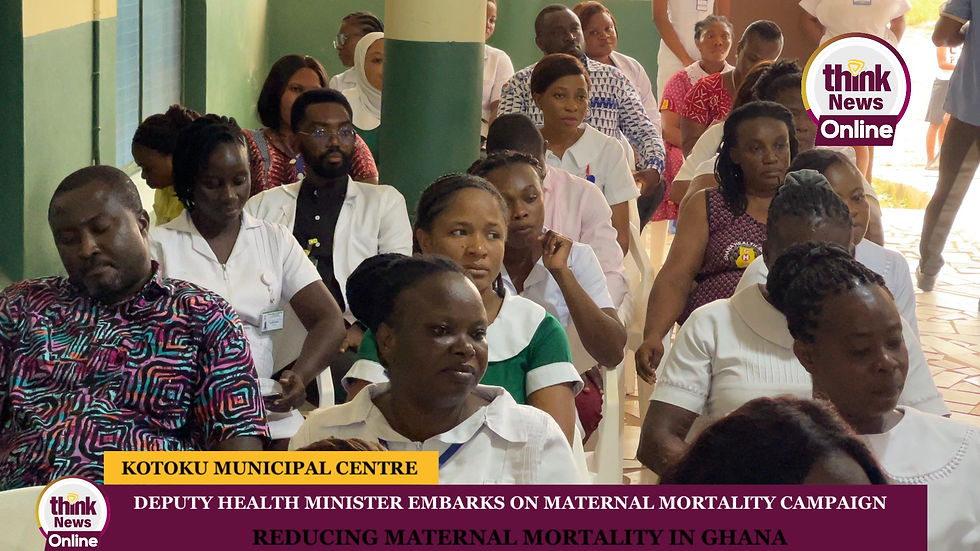
According to her, the roadmap will integrate the contributions of government institutions, development partners and organisations working in maternal and child health, while introducing greater uniformity, quality assurance and accountability in maternal healthcare delivery across the country.
She explained that although health facilities differ in size and capacity, pregnant women should receive the same standard of quality care wherever they seek treatment.

"When a pregnant woman walks into any health facility in Ghana, the quality of care she receives should not depend on where she lives. We want to build a system with consistency, quality control and better tracking of maternal health outcomes," she stated.
Drawing from her experience as a medical specialist trained and licensed in Ghana, the Deputy Minister likened the nationwide assessment to a clinical diagnosis, explaining that understanding the root causes of maternal deaths is essential before prescribing effective solutions.

"Our diagnosis is becoming clearer," she noted.
She identified one of the most pressing challenges as the failure of some health facilities to recognise and act promptly on high-risk pregnancies.
According to Prof. Ayensu-Danquah, health workers sometimes document life-threatening clinical findings—including severely elevated blood pressure and critically low haemoglobin levels—without initiating the urgent interventions required to save lives.

She cited instances where pregnant women recorded blood pressure readings as high as 192/103 mmHg, yet no immediate clinical action was taken despite the significant risk of complications such as eclampsia and maternal death.
She also drew attention to severe anaemia in pregnancy, describing it as a major contributor to maternal mortality in Ghana.

The Deputy Minister explained that pregnant women who crave and consume non-food substances such as chalk may be exhibiting pica, a recognised medical condition that often signals severe anaemia and requires immediate medical evaluation.
She urged healthcare workers to strengthen their clinical assessment skills and not rely solely on laboratory investigations, noting that signs such as pale palms, pale mucous membranes and general body weakness can provide early indications of severe anaemia.

Prof. Ayensu-Danquah further emphasised the importance of identifying high-risk pregnancies early at Community-based Health Planning and Services (CHPS) compounds, health centres and district hospitals to ensure timely referral and treatment before complications develop.
She expressed confidence that the proposed National Maternal Mortality Roadmap would establish a coordinated national response to maternal mortality, standardise maternal healthcare practices and improve the quality of services available to women across Ghana.

The working visit forms part of the Ministry of Health's broader efforts to engage frontline healthcare workers, strengthen maternal healthcare systems and accelerate progress towards reducing preventable maternal deaths nationwide.
Story by: Joshua Kwabena Smith


Comments