


“Reliable data is critical for effective governance” – Chief of Staff


The Chief of Staff at the Office of the President, Julius Debrah, has emphasised the importance of reliable data in strengthening governance and supporting evidence-based decision-making across government institutions.
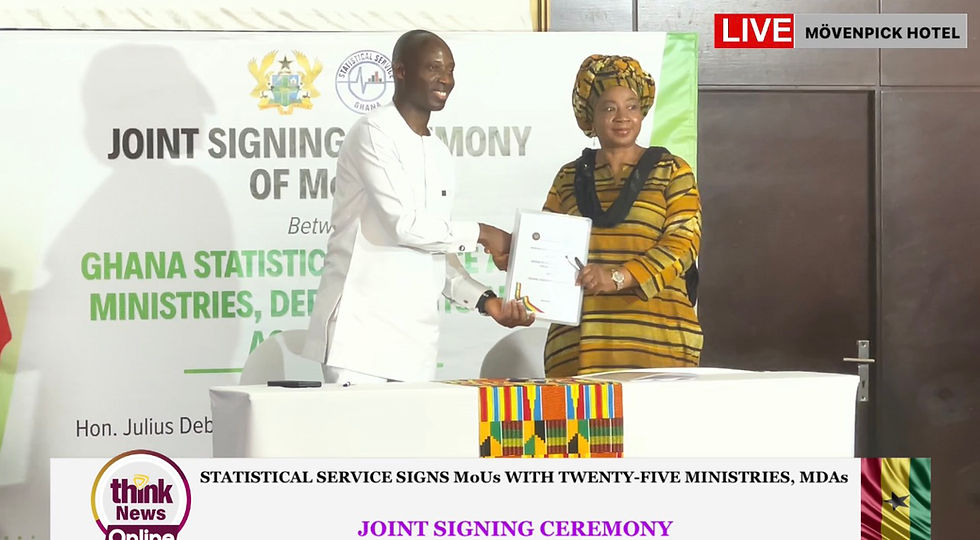
Speaking at a joint signing ceremony of Memoranda of Understanding (MoUs) between the Ghana Statistical Service and 25 Ministries, Departments and Agencies (MDAs) in Accra on Thursday, March 12, 2026, Mr. Debrah said accurate and coordinated data systems are essential for effective national planning and policy implementation.

The ceremony, held at the Mövenpick Ambassador Hotel, forms part of efforts to strengthen Ghana’s National Statistical System and improve collaboration among public institutions that generate administrative data.
Mr. Debrah noted that every major government decision rests on the availability of reliable information.

“Every major decision taken by government rests on one foundation — information. When that information is reliable, decisions are confident. When it is incomplete or inconsistent, decisions become uncertain,” he stated.
According to him, government institutions generate large volumes of administrative data daily across sectors such as education, health, trade, immigration, environmental protection and social protection.

He explained that this information forms the foundation for planning, budgeting, monitoring and evaluating national development programmes.
However, he acknowledged that a long-standing challenge within the public sector has been the fragmentation of data systems across institutions.

“Different institutions often operate with different definitions, reporting timelines and data standards. As a result, government sometimes receives multiple versions of the same reality, which weakens the ability of policymakers to make timely and confident decisions,” he said.
Mr. Debrah described the signing of the MoUs as a decisive step toward building a more coordinated and coherent national data ecosystem.

He explained that the agreements will strengthen the mandate of the Ghana Statistical Service to coordinate the National Statistical System under the Statistical Service Act, 2019 while creating a practical framework for data sharing and collaboration across government institutions.
Through harmonised data standards and structured information sharing, he said the initiative will help transform administrative data into a strategic national asset for development.

Mr. Debrah further stressed that credible statistics play a crucial role in governance, influencing how governments allocate resources, measure progress and strengthen accountability to citizens.
He noted that John Dramani Mahama has consistently emphasised the need to strengthen Ghana’s statistical and data systems as part of efforts to build a modern and efficient public sector.
Quoting the President, he said: “Sound decisions must be rooted in sound data.”

Mr. Debrah also disclosed that the 2026 national budget has made deliberate provisions to support priority statistical initiatives and strengthen the capacity of the Ghana Statistical Service to coordinate the National Statistical System.
He described statistics as critical national infrastructure that connects government decisions to reality, similar to how roads and digital networks connect communities and economies.

According to him, the agreements will also help address long-standing challenges such as fragmented information systems, inconsistent datasets, delays in reporting and duplication of effort across institutions.
He added that improved coordination among institutions will enable government to access more reliable information for policymaking, while allowing public institutions to operate more efficiently through shared systems and common standards.

Mr. Debrah, however, stressed that the real impact of the agreements will depend on effective implementation by all participating institutions.
“The real work begins after the signatures are appended to these agreements. Institutions must ensure that administrative data is recorded accurately, updated regularly and managed professionally,” he stated.

He therefore urged Chief Directors and heads of public institutions to prioritise data governance within their organisations by strengthening statistical units, respecting data standards and adhering to reporting timelines.
Mr. Debrah assured that the Office of the President will continue to support the initiative and work closely with the Ghana Statistical Service to monitor progress.

“When data improves, governance improves. When governance improves, development outcomes improve, and ultimately the lives of our citizens improve,” he said.
He commended the Ghana Statistical Service and all participating institutions for their commitment to strengthening Ghana’s National Statistical System and promoting evidence-based policymaking in the country.

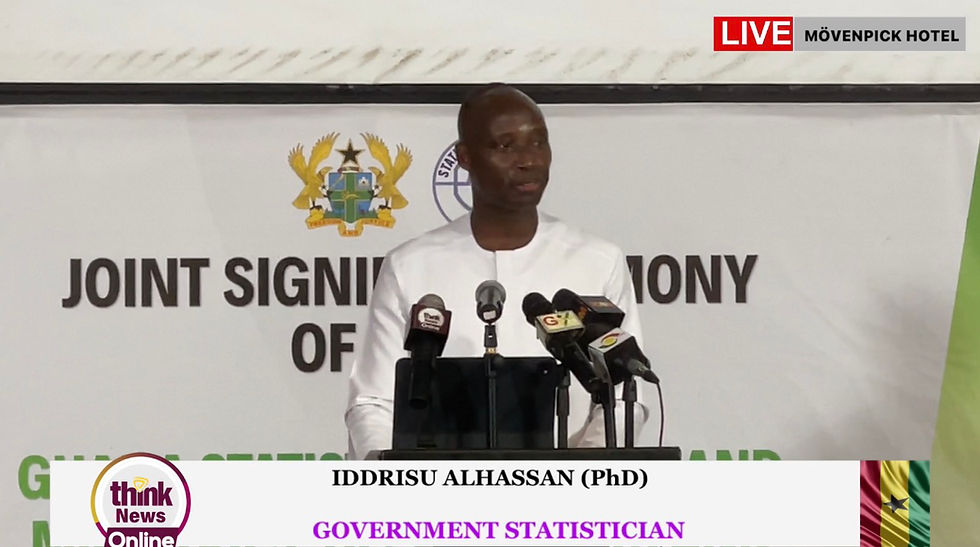
On his part, Government Statistician, Dr. Alhassan Iddrisu, stressed the importance of strengthening data governance and collaboration across public institutions to support economic planning and evidence-based policymaking in Ghana.
According to Dr. Iddrisu, government institutions generate large volumes of administrative data every day across sectors such as health, education, public safety, immigration, environmental management and economic activity.
However, he noted that much of this information has historically remained fragmented across institutions, often stored in different systems and managed under varying standards.

“For many years, much of this information has remained fragmented across institutions, stored in different systems, managed with different standards, and often not easily accessible for national planning and policymaking,” he stated.
He explained that the MoUs signed between the Ghana Statistical Service and the 25 MDAs are designed to address these long-standing challenges by creating clear frameworks for data sharing, quality assurance and coordination across government institutions.

Dr. Iddrisu noted that the agreements outline what data will be shared, how it will be shared and the timelines for sharing such information.
They also designate focal persons within institutions and establish technical standards and review mechanisms to ensure effective implementation.
He emphasised that the initiative represents a major cultural shift within the public sector—from fragmented data systems toward more connected and collaborative information management.

“This represents a shift from institutional silos to institutional collaboration and from data that sits in isolated databases to data that actively informs national decisions,” he said.
The Government Statistician noted that the 25 institutions involved in the agreements form a critical administrative data backbone for the country.
They include key ministries and agencies responsible for governance, economic transformation, social protection, natural resources, infrastructure and technology.
Among the agencies referenced were the Ghana Health Service, Ghana Police Service, Ghana Immigration Service, Environmental Protection Authority, National Communications Authority, National Disaster Management Organisation and the Births and Deaths Registry.

Dr. Iddrisu explained that the initiative is anchored in the Statistical Service Act, 2019, which mandates the Ghana Statistical Service to coordinate the National Statistical System and establish standards for official statistics while ensuring responsible data sharing and confidentiality.
Beyond the MoUs, he revealed that the Ghana Statistical Service is also rolling out three major national frameworks aimed at strengthening the production and use of official statistics.

These include the Data Quality Assurance Framework (DQAF), which sets standards to ensure the accuracy and reliability of official statistics; the Code of Ethics and Practice for the National Statistical System, which promotes professionalism and confidentiality in statistical production; and the National Strategy for the Development of Statistics (NSDS III), which provides the roadmap for modernising Ghana’s statistical system.
Dr. Iddrisu disclosed that implementation of the agreements will begin immediately, with the Ghana Statistical Service working closely with partner institutions to finalise data-sharing policies, strengthen statistical units within MDAs and operationalise technical standards that will support interoperability across government data systems.
He further revealed that 17 ministries, departments and agencies have already developed draft data-sharing policies, which are currently being refined before being made publicly accessible to enhance transparency and responsible data use.
Dr. Iddrisu expressed optimism that the initiative will lead to a more coordinated National Statistical System, improved administrative datasets and faster, more informed decision-making across government.

“When data is timely, harmonised and credible, policies become smarter, public resources are used more efficiently and accountability becomes stronger,” he said.
He therefore urged public institutions to prioritise data governance and ensure that administrative data is properly recorded, managed and shared to support national statistical production and economic development.
According to him, strengthening Ghana’s statistical infrastructure will ultimately enhance policy coordination, improve public service delivery and support sustainable development outcomes for citizens.

Taking Deputy Minister for Finance and Member of Parliament for Asuogyaman, Thomas Nyarko Ampem, has emphasised the importance of strong statistical systems in guiding national economic planning, budgeting and policy implementation.
Mr. Ampem noted that reliable data remains the backbone of effective governance and sound economic management.
According to the Deputy Finance Minister, the agreements between the Ghana Statistical Service and the participating MDAs represent more than administrative arrangements.

“They represent a national commitment to institutional coordination, data integrity and informed policymaking,” he stated.
Mr. Ampem explained that the Ministry of Finance places high value on strong and reliable data systems because national budgets, fiscal policies and development programmes depend heavily on accurate statistics.
“For the Ministry of Finance, the value of strong data systems cannot be overstated. Every budget we prepare, every fiscal policy we design and every development programme we implement depends on accurate, strong and timely statistics,” he said.
He noted that when government decisions are supported by credible data, policy implementation becomes more effective, public resources are allocated more efficiently and accountability to citizens is strengthened.

The Deputy Finance Minister also recalled that discussions on improving Ghana’s statistical ecosystem began during the Annual Forum for Producers and Users of Data held in December last year.
According to him, that forum brought together key stakeholders to deliberate on reforms needed to strengthen the country’s statistical systems and improve collaboration among public institutions.
“One key message from that meeting was clear: Ghana’s development ambitions must be supported by stronger data collaboration across government institutions,” he said.

Mr. Ampem stressed that policies must be guided by facts, budgets must be informed by evidence and national planning must rely on reliable statistics.
He added that the MoUs being signed will help improve administrative data sharing across government institutions, strengthen coordination within the National Statistical System and enhance the quality and reliability of official statistics.
The agreements, he said, will also support better monitoring of national development priorities and improve government’s ability to measure progress and evaluate the impact of policies.

Mr. Ampem further noted that countries that invest in strong statistical systems tend to achieve better policy outcomes because data has become a strategic national asset in modern governance.
He commended the ministries, departments and agencies participating in the agreements for demonstrating commitment to building a modern and responsive national data ecosystem.
According to him, collaboration among institutions remains essential in strengthening Ghana’s data infrastructure and ensuring that government decisions are based on reliable information.

Mr. Ampem, however, stressed that the success of the initiative will depend on effective implementation of the agreements after the signing ceremony.
“These agreements must translate into practical institutional cooperation, stronger administrative data systems and continuous capacity building across our institutions,” he said.
He expressed confidence that if successfully implemented, the initiative will position Ghana to better measure development progress, evaluate policy outcomes and deliver improved economic and social benefits to citizens.

“Together, we must build a Ghana that plans with data, acts with evidence and delivers results for the people,” he added.
Head of the Civil Service of Ghana, Evans Aggrey-Darkoh, underscored the importance of credible data systems in improving public administration and strengthening the delivery of government services.
According to Dr. Aggrey-Darkoh, the Civil Service plays a critical role in implementing national policies and development programmes, making the availability of credible and well-managed information systems essential for effective governance.

“Planning requires reliable data, monitoring requires reliable data, and evaluating the impact of policies also requires reliable data,” he said, adding that improving public service delivery equally depends on the availability of accurate information.
He noted that the MoUs represent a practical step toward strengthening data governance within government institutions and improving the way administrative data is generated, managed and used in decision-making.
Dr. Aggrey-Darkoh revealed that when the Ghana Statistical Service approached his office in 2024 to support the initiative, the Civil Service immediately recognised its significance and offered its full backing.

He commended the Office of the President, particularly the Chief of Staff, Julius Debrah, for providing leadership and coordination in promoting data-driven governance across the public sector.
He also praised the Government Statistician, Alhassan Iddrisu, the governing board of the Ghana Statistical Service and the technical teams from the participating ministries and agencies for their commitment to strengthening the country’s statistical ecosystem.
Dr. Aggrey-Darkoh explained that the agreements will help ministries and agencies improve the way administrative data is collected, analysed and used to inform policy decisions and performance management within the public sector.

He noted that the MoUs will also reinforce the implementation of two key national frameworks recently approved for the National Statistical System — the Code of Ethics and Practice for the National Statistical System and the Data Quality Assurance Framework.
According to him, these frameworks promote professionalism, accountability and integrity in the production and use of official statistics, while ensuring that public institutions generate data that is accurate, consistent and reliable.
Dr. Aggrey-Darkoh urged ministries, departments and agencies to ensure disciplined implementation of the agreements by strengthening internal data systems, supporting statistical and information management units, and adhering to agreed standards and timelines for data production.

He also encouraged the Ghana Statistical Service to work closely with ministries and agencies to develop Sector Statistics Plans that will guide the improvement of data systems within individual sectors.
The Head of the Civil Service assured that his office will continue to collaborate with relevant institutions to monitor the implementation of the agreements and ensure effective coordination across government.
He added that strengthening data systems forms part of broader reforms within the Civil Service aimed at building a more responsive, results-oriented and accountable public sector.

“When information systems improve, institutions perform better, and when institutions perform better, citizens receive better services,” he said.
Dr. Aggrey-Darkoh expressed confidence that the collaboration between the Ghana Statistical Service and the participating ministries and agencies will significantly improve how government institutions generate and use data to drive national development.
Story by: Joshua Kwabena Smith and Hawa Abubakar


Comments