


“Health remains central to productivity, economic resilience and national security” - Vice President


Vice President Jane Naana Opoku-Agyemang has called on African countries to adopt bold and practical measures to bridge the gaps in the training and retention of health professionals, stressing that health remains central to productivity, economic resilience and national security.
Speaking at the opening of the Second Africa Health Workforce Investment Forum in Accra on Wednesday, Prof. Opoku-Agyemang questioned why many African countries continued to lose trained health workers despite investing heavily in their education and development.
“What makes it so easy for us to use scarce resources to train, and what makes it so difficult for us to retain the people we have trained?” she asked.
The forum, organised by the World Health Organization in partnership with the Government of Ghana and other stakeholders, brought together heads of state, ministers, development partners, global health experts and private sector actors to advance implementation of the Africa Health Workforce Investment Charter.

According to the WHO, nearly 500,000 health workers were trained across Africa between 2022 and 2024. However, one in every ten has already migrated from the continent, while four in ten are considering leaving in search of better opportunities abroad.
Prof. Opoku-Agyemang noted that although progress had been made in life expectancy and healthcare delivery, access to universal healthcare remained a challenge for many due to high costs, long distances and inadequate services.
She highlighted ongoing government interventions aimed at strengthening Ghana’s health sector, including the rollout of the Free Primary Health Care programme to improve access to essential healthcare services irrespective of insurance coverage.
The Vice President also referenced the Ghana Medical Trust Fund, which supports persons battling chronic and high-cost illnesses through investment in specialist care, treatment facilities and medical equipment.
She stressed that the success of such initiatives depended heavily on a strong and motivated health workforce, describing healthcare professionals as the backbone of national health sovereignty.

Prof. Opoku-Agyemang disclosed that government had prioritised the training, recruitment and fair distribution of health personnel nationwide, with about 16,000 health workers expected to be employed this year, many of whom had already received clearance.
Minister of Health Kwabena Mintah Akandoh said despite improvements in the number of doctors, nurses and midwives across the continent, African countries still faced challenges relating to deployment, equitable distribution and staff retention.

He revealed that Ghana had undertaken a comprehensive health labour market assessment to guide policy reforms and was implementing a national health workforce development strategy to align training, employment and service delivery.
Mr Akandoh further announced plans to introduce structured workforce exchange programmes aimed at ensuring ethical and mutually beneficial labour mobility while safeguarding Ghana’s healthcare needs.

“These programmes are intended to promote ethical, regular and mutually beneficial labour mobility, protect the needs of Ghana’s health system and create organised opportunities for young Ghanaian health professionals to gain international experience,” he said.
WHO Regional Director for Africa, Mohamed Yakub Janabi, also called for stronger international collaboration and co-investment initiatives to support the training and retention of healthcare professionals across the continent.
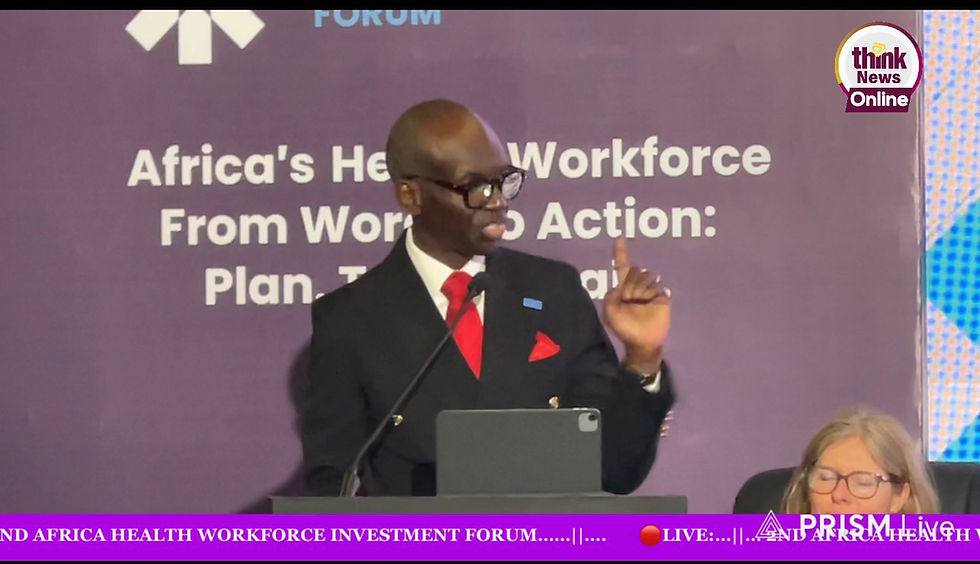
He urged African leaders and development partners to move beyond policy discussions and focus on practical implementation that would deliver measurable improvements in healthcare systems.
“Documents have never saved lives. Actions have done,” Prof. Janabi stated.

He further advocated structured government-to-government partnerships that would align international recruitment with investments in training institutions to sustain Africa’s health workforce and reduce migration pressures.
Story by; Joshua Kwabena Smith


Comments